
15-Minute Daily Typing Routine for SSC & Govt Exams (2026)
There is a specific kind of silence in a government exam hall. It's that heavy, electric tension where the only thing you can hear is the rhythmic thwack-thwack-thwack of a hundred keyboards firing at once. If you've ever been there, you know the feeling: your palms get sweaty, your heart races, and suddenly, that 45 WPM you hit comfortably in your bedroom vanishes the moment the countdown clock turns red.
I've mentored thousands of aspirants for SSC CHSL, CGL, IBPS, and Railway exams, and the story is always the same: Raw speed isn't what wins; it's consistency under pressure. You don't need five hours of practice a day-that just leads to burnt-out wrists and "autopilot" errors. You need a focused, 15-minute tactical strike.
This is the exact routine I give to every candidate. For a full breakdown of what you're up against, see our SSC & Govt Exam Guide, and pair this routine with our comprehensive prep roadmap.
Why does "At-Home" speed often fail in the exam hall?
Most people practice "lazy typing." They type a few words, check their phone, hit backspace ten times, and eventually finish a 5-minute test. In a real exam, that behavior is a death sentence. Here's why we have to train differently:
- The "Keyboard Lottery": You won't be using your sleek, silent laptop. You'll likely be handed a standard, slightly dusty, "clunky" membrane keyboard. If you haven't practiced on one, your fingers will feel like they're typing through mud.
- The Single Shot: Most exams gave you one chance. No "Try Again" button. One mistake can trigger a cascade of panic.
- Penalties for Errors: In SSC exams, especially, accuracy is everything. 2000 key depressions must be hit with at least 95% accuracy. A few missed spaces or commas, and you're disqualified regardless of your 60 WPM speed.
What is the best 15-minute routine for exam success?
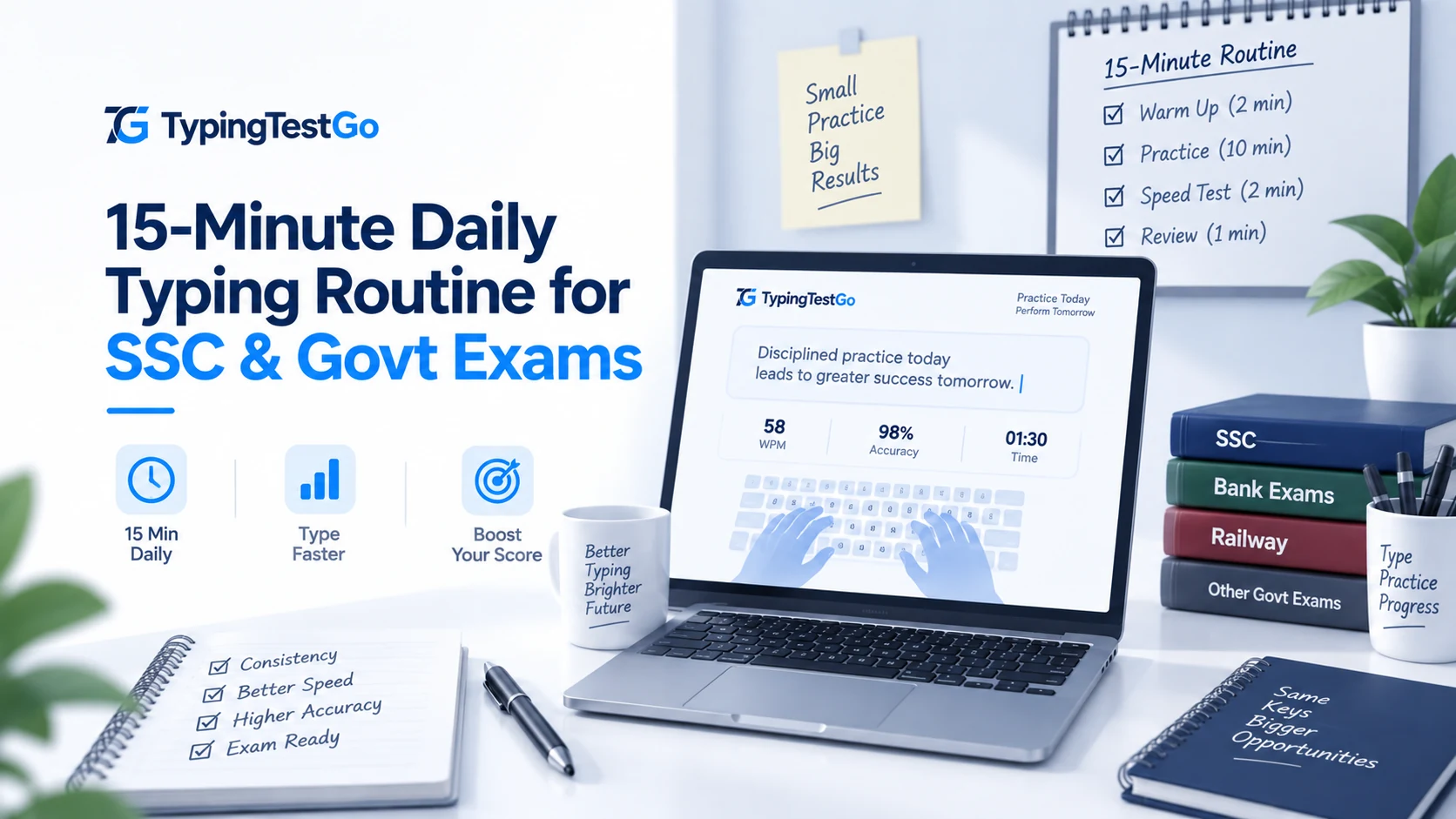
We're going to split your practice into three 5-minute "Sprints." Do this once in the morning and once in the evening if you can-but never do more than 20 minutes in a single sitting. Quality over quantity.
Sprint 1 (0-5 Min): The "Perfect 100" Warm-Up
Goal: Wake up your muscle memory without the stress of speed.
- Open TypingTestGo and select the "1-Minute Test."
- Select the "Prose" or "Normal" mode"”don't do easy words yet.
- The Rule: You are not allowed to type fast. Type at a crawling pace if you have to, but your accuracy must be 100%. If you make a single error, finish the minute, then restart.
- Complete three of these "Perfect" rounds.
Ready to start Sprint 1?
Don't just read about it. Test your "Perfect 100" accuracy right now before moving to Sprint 2.
Launch 1-Minute Accuracy Test →Why this matters: This forces your brain to focus on finger placement rather than speed. It calms the "Timer Panic" before it starts.
Sprint 2 (5-10 Min): The "Endurance" Block
Goal: Battle the "Middle-Minute Slump."
- Choose a 5-minute English test (SSC-style passage).
- Type at a "conversational" speed"”about 80% of your maximum.
- The Challenge: Around the 3-minute mark, your mind will start to wander. You'll start thinking about the score or the timer. When that happens, take one deep breath through your nose and refocus on the *next three words*.
Why this matters: Most errors happen in the middle of the test when your focus dips. This block trains your brain to stay locked in for the full duration.
Sprint 3 (10-15 Min): The "Exam Simulation"
Goal: Survive the countdown.
- Open a full exam-style test. If you're targeting SSC, take a proctored mock on our dedicated SSC CGL Typing Test Simulator or practice regional benchmarks on the CPCT Typing Test Simulator. Aim for reaching 2,000 key depressions with under 5% errors.
- Simulate the Noise: If possible, play a "Typing Sound" or "Office Noise" video in the background. It sounds crazy, but the clatter of other typists is the #1 distraction in the hall.
- Type for the full duration. No stopping. No checking the result until the time is up. Review official penalty rubrics in our Indian Govt Exam Guide.
What should you audit immediately after finishing your 15-minute routine?
If you just close the tab after 15 minutes, you're only doing 50% of the work. You need to look at your errors. Are you consistently missing the same letter? Do you struggle with capital letters?
The "Weak Key" Fix
If you find that you're always missing the 'P' or 'B' key, spend 30 seconds after your routine typing just those words over and over. "Bubble, Bubble, Bubble..." "Purple, Purple, Purple..." It sounds silly, but it rewires your brain instantly by targeting motor-unit lag.
How do I choose the best keyboard for exam practice?
I see so many aspirants practicing on expensive mechanical gaming keyboards. Stop.
The exam center will almost certainly provide a basic, membrane keyboard (like a standard Dell or HP office keyboard). Gaming keyboards have "shallow" actuation"”the keys click easily. Office keyboards require a deeper, firmer press. If you only practice on a gaming keyboard, you will find yourself "miss-keying" in the exam hall because the keys feel too heavy. Buy a cheap ₹500 standard keyboard for your practice. It's the best investment you'll make.
How much typing progress can I expect in 30 days?
Consistency isn't just about showing up; it's about seeing the data. Use this table (or a physical notebook) to track your 15-minute bursts. I promise you, seeing that WPM climb from 25 to 35 over a month is the best motivation you've ever had.
| Phase | Warm-Up Accuracy | 5-Min Stable WPM | Final Sprint WPM | The Goal |
|---|---|---|---|---|
| Week 1: Foundations | 98%+ | 22-25 | 20-22 | Fix Home Row placement |
| Week 2: Rhythm | 99%+ | 28-30 | 25-28 | Stop the "Backspace Habit" |
| Week 3: Endurance | 99%+ | 32-35 | 30-32 | Handle the 3-minute slump |
| Week 4: Exam-Ready | 100% | 38-40 | 35-37 | Ace the test with a buffer! |
How can I break through a persistent 30 WPM plateau?
Almost everyone gets stuck at 30 WPM for a few days. It's frustrating. Here is how I help my students break through:
- The Metronome Method: Open an online metronome and set it to 60 BPM, or use our built-in Ghost Pace Pacing Trainer to race against a consistent shadow caret dialed precisely to your target exam speed (35 or 40 WPM). This builds a steady rhythmic pulse and prevents your fingers from tripping under examination pressure.
- Eyes Up: If you are still looking at your keys, even for a second, you will never pass a modern exam. Tape a piece of paper over your hands if you have to-force your brain to *feel* the keyboard.
- Rest is Productive: If your wrists hurt or your scores are dropping, stop. Muscle memory is built during sleep, not during the 16th hour of practice.
What are the 3 fatal mistakes candidates make in the typing hall?
I've watched hundreds of candidates fail tests they were prepared for. Don't let these be you:
- The "Turbo" Start: Candidates start at 100mph, make three errors in the first line, panic, and never recover. Start slow. Build the speed *after* the first two minutes.
- Ignoring Numbers & Symbols: Many SSC passages include years (1947, 2026) or percentages. If you only practice lowercase letters, a single date will ruin your rhythm.
- Laptop Dependency: As I mentioned before, if you prepare on a laptop but take the test on a desktop, you will lose at least 5-10 WPM instantly. Practice on the real gear.
How can you start your Day 1 exam routine right now?
Your exam date is a deadline, but it's also an opportunity. 15 minutes is less time than it takes to scroll through social media. Give yourself this time. You've worked hard for the written exams-don't let a typing test be the thing that stands between you and your dream job.
Test your baseline right now on our Typing Course and start Day 1 of your routine today. You've got this!