
Fastest Typing Speed in the World: World Records & Human Limits (2026)
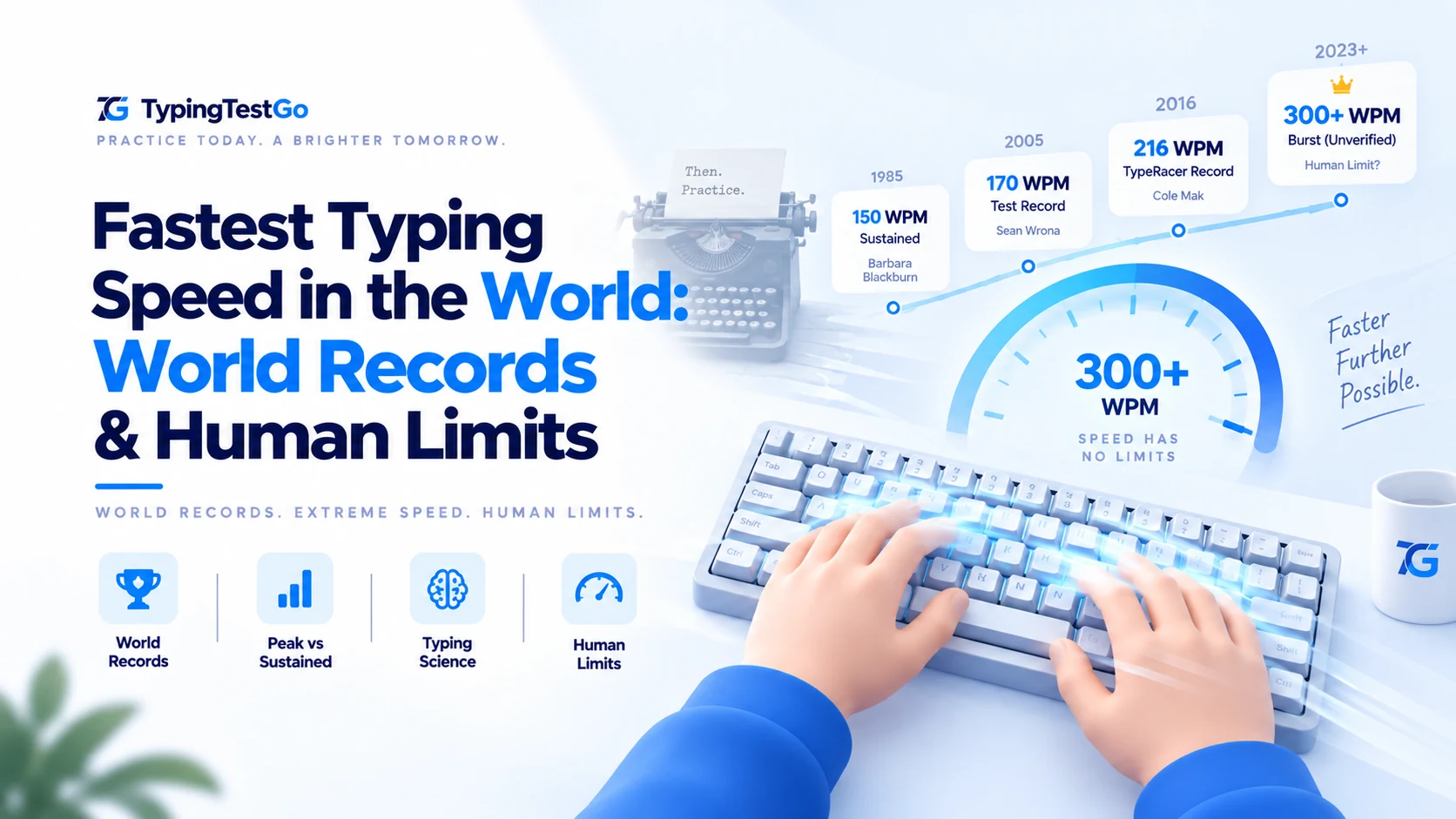
TL;DR: A 200 WPM claim is meaningful only when the test length, accuracy, keyboard, and input method are stated. On a standard keyboard it is an elite benchmark; stenotype machines use chorded input and should be compared separately. This page covers possibility and verification, while the 200 WPM training guide covers practice strategies.
Quick Facts: Current Typing World Records (2026)
- Fastest typists on modern QWERTY: MythicalRocket (216+ WPM sustained for 60 seconds with 100% accuracy) and Sean Wrona (256 WPM burst peak).
- Guinness World Record (Dvorak): Barbara Blackburn (212 WPM peak, 150 WPM sustained for 50 minutes).
- Historical Electric Typewriter Record: Stella Pajunas (216 WPM on an IBM electric typewriter in 1946).
- Stenotype World Record: Mark Kislingbury (360 WPM with 97% accuracy in 2004).
The Biological Speed Limit of Typing
When you first start learning, reaching 100 WPM seems like pure magic. But as you get faster, you start wondering what the absolute limit actually is. Can a person really type 300, 400, or 500 words per minute?
To understand the ceiling, we need to look at the mechanical reality of typing. A standard QWERTY keyboard needs one finger press per letter. At 100 WPM, you are pressing roughly 500 keys every minute. That is over 8 keys per second. To hit 200 WPM, your fingers have to strike the board more than 16 times per second.
At these ridiculous speeds, you run into two massive roadblocks:
- Mechanical limits: Even the most expensive optical gaming switches take a few milliseconds to actuate and spring back up. The hardware physically cannot move fast enough.
- Neural limits: Your nervous system takes time to send electrical signals from your brain to your fingertips. Even with perfect muscle memory, human muscle twitch speed maxes out around 20 to 25 movements per second.
| Speed Tier | Keystrokes / Sec | Inter-Key Interval | Primary Limiting Constraint | Input Modality |
|---|---|---|---|---|
| 40 WPM (Average) | 3.3 KPS | ~300 ms | Visual letter hunting; cognitive hesitation | Visual confirmation (hunt-and-peck / novice touch) |
| 80 WPM (Proficient) | 6.7 KPS | ~150 ms | Syllable chunking; motor path consistency | Subconscious muscle memory (QWERTY) |
| 120 WPM (Advanced) | 10.0 KPS | ~100 ms | Finger travel optimization; same-finger bigram latency | Parallelized motor planning |
| 160 WPM (Elite) | 13.3 KPS | ~75 ms | Tendon elasticity; peripheral finger travel speed | Chorded word rolling (Home row mastery) |
| 216+ WPM (Human QWERTY Record) | 18.0 KPS | ~55 ms | Absolute neurological refractory period of motor units | Zero-lookahead decoupling; pure proprioception |
| 360 WPM (Stenotype Record) | 6.0 Strokes / Sec | ~165 ms | Phonetic shorthand transcription translation | Multi-key chording (one chord = one word/phrase) |
The Neuro-Physiology of Keystroke Execution
Reaching elite typing velocity requires the human central nervous system to operate near its absolute biological limits:
- Nerve Conduction Velocity: Action potentials travel along the myelinated axons of the median and ulnar nerves at approximately 50 to 60 meters per second. From the cervical spine to the intrinsic muscles of the hand (the lumbricals and interossei), nerve transmission requires roughly 15 to 20 milliseconds per motor impulse.
- Motor Unit Refractory Period: After a skeletal muscle fiber twitches in response to a nerve impulse, it enters a mandatory absolute refractory period during which it cannot contract again. For individual distal finger flexors, this cycle requires 35 to 45 milliseconds. This means a single human finger cannot physically tap a single key faster than approximately 8 to 10 times per second.
- Interleaved Parallelism: The only reason human typists can exceed 15 keystrokes per second is interleaving: while the right index finger is in its refractory recovery phase, the left middle finger is already in downward descent. Once all available digits are fully saturated, human serial input reaches an immovable physiological wall.
Why Chording Transcends Serial Typing Physics
If you want to produce text faster than 250 WPM, the English alphabet itself becomes the bottleneck. Serial typing demands that the word "jurisdiction" consume 12 distinct sequential keystrokes. At 18 keystrokes per second, that single word requires over 660 milliseconds of finger movement.
Professional court reporters bypass this through Stenotype Chording. A stenotype keyboard features only 22 unlabelled keys. Instead of typing letter-by-letter, the operator presses combinations of keys simultaneously—much like playing a chord on a piano. The word "jurisdiction" is entered in a single stroke (SKWRURDZ). By collapsing multi-letter words into single instantaneous chords, stenographers generate 300 to 360 WPM with less physical finger travel than an office clerk typing at 60 WPM.
Today, through the open-source Plover project, typists can even emulate stenotype chording on consumer mechanical keyboards that support N-Key Rollover (NKRO). While the steep learning curve takes 12 to 18 months of intensive dictionary drilling, it remains the only verified software method to break past 240+ WPM without violating human biological limits.
The Truth About 300, 400, and 500 WPM
Is 300 WPM possible?
On a regular computer keyboard, 300 WPM would require about 25 keystrokes per second sustained over a full minute. Treat claims at this level carefully: compare the test duration, accuracy, keyboard, and whether the result is a burst score or a sustained result. For documented historical records, see the verified typing records guide.
The catch: 300 WPM is totally doable if you use a Stenotype machine. Court reporters use these weird specialized keyboards to type in phonetic shorthand. They mash multiple keys at once to form whole syllables. Since one stroke equals an entire word, 300 WPM is just a normal Tuesday for a good stenographer.
Is 400 WPM possible?
Not on a normal keyboard. Even the best human typists top out around 210 WPM. However, 400 WPM is technically possible for world class stenographers. Mark Kislingbury holds the Guinness World Record for stenography by hitting a crazy 360 WPM in 2004 with 97% accuracy. Hitting 400 WPM would be the absolute peak of human potential.
Is 500 WPM possible?
500 WPM is impossible for a human on any typing device, period. At this speed, you would need to process and spit out over 8 words every single second. Your brain cannot process language that fast, let alone move your hands. At 500 WPM, we are talking about computers and speech recognition software, not humans.
Curious About Historical World Records?
If you want to read more about the legendary typists like Stella Pajunas and Barbara Blackburn who set records on early typewriters and Dvorak keyboards, check out our deep dive into the Highest Verified Typing Speeds in History.
What is considered an elite typing speed today?
If 300 WPM is fake, what speeds should you actually care about in the real world?
Is 100 WPM fast?
Yes, 100 WPM is incredibly fast. It puts you in the top 1% or 2% of typists globally. At 100 WPM, you can basically type as fast as someone speaks. This makes you a total powerhouse in any office, coding job, or creative role.
Is 90 WPM fast?
Definitely. 90 WPM is an elite speed that lands you comfortably in the top 5% worldwide. It is more than double the global average of 40 WPM and will easily get you hired for transcription, programming, or heavy data entry jobs.
The Final Verdict
Stop chasing the 300 WPM myth on normal keyboards. If you can type between 90 WPM and 120 WPM, you are already at a point where your keyboard is no longer slowing you down. Spend your time learning keyboard shortcuts and ergonomics instead of trying to break physics.