
Gross vs Net Typing Speed: The Difference & How WPM is Calculated
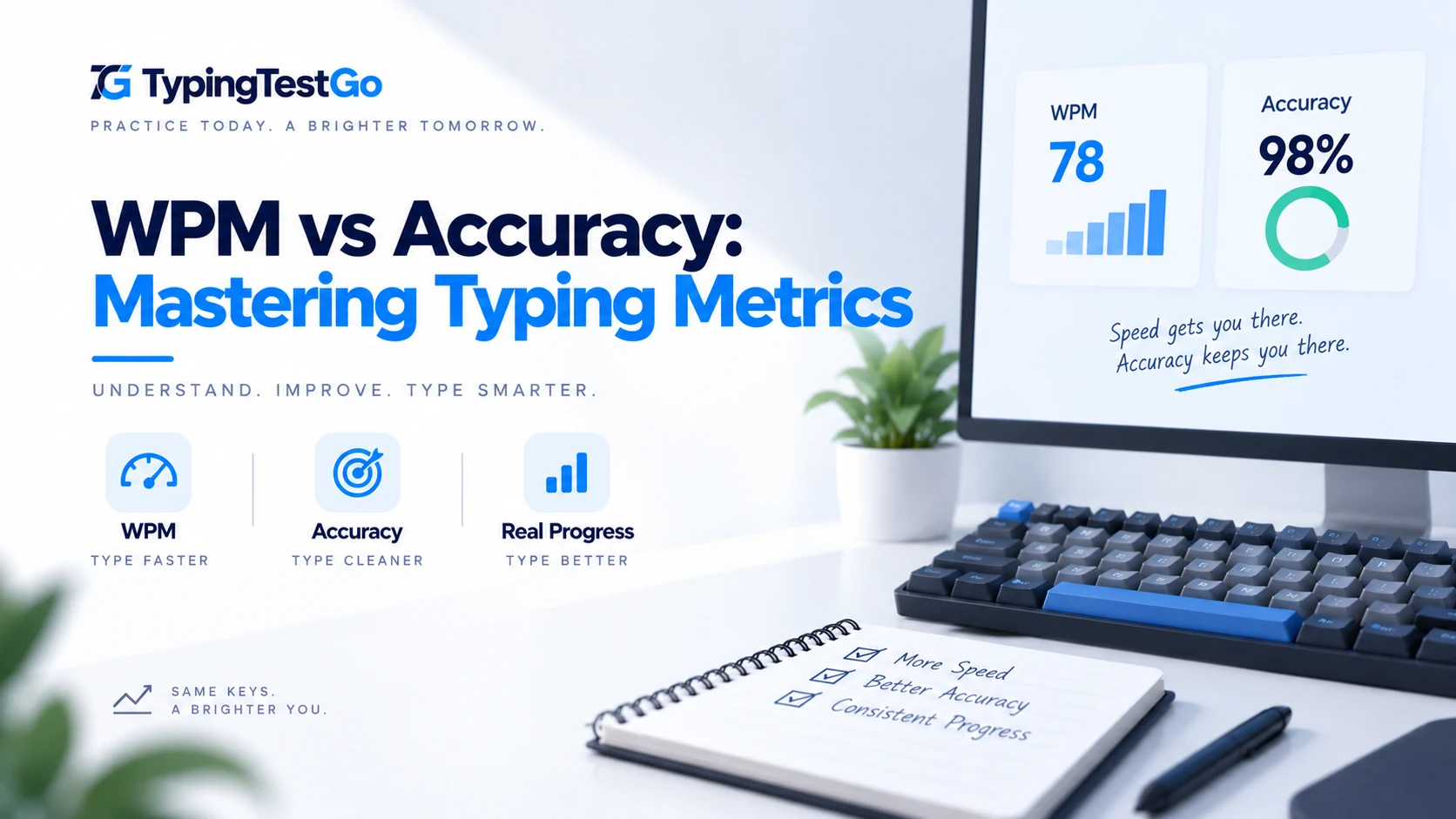
We’ve all been there: you finish a typing test, see a flashing 100 WPM on the screen, and feel like a god. But then you look at the fine print. 84% accuracy. FUNCTIONALLY useless. In any real-world scenario-be it a high-stakes government exam or a professional transcription project-that 100 WPM is actually a failing grade.
In 2026, raw speed has become a Vanity Metric. Anyone can "burst" type at 100 WPM for ten seconds. The true masters are those who understand the deep metadata: Net WPM, Key Release Latency, and Consistency. This guide is your masterclass in the analytics that actually matter for elite performance.
Analyze your real Net WPM and accuracy breakdown
Test your typing with real-time error telemetry, Net WPM penalties, and millisecond keystroke latency.
How has typing measurement evolved from stopwatches to millisecond telemetry?
In the early 20th century, typing speed was measured with a physical stopwatch and a manual count of "five-character groups." A "word" was mathematically defined as exactly five characters (including spaces) because it was the only way to normalize scores across different texts. If you typed "the " (four characters), it wasn’t a word yet.
Today, we have moved from the stopwatch to High-Frequency Telemetry. Modern platforms don’t just count words; they measure the exact millisecond your finger leaves the "S" key and travels to the "T." We are no longer measuring just output; we are measuring Neural Efficiency. Understanding these mechanical patterns is the first step toward true mastery.
What are the most important typing metrics to track?
| Metric | What It Measures | Good Score | Expert Score |
|---|---|---|---|
| WPM (Words Per Minute) | Typing speed | 40-60 | 80-100+ |
| CPM (Characters Per Minute) | Raw character speed | 200-300 | 400-500+ |
| Accuracy (%) | Correctness | 95-98% | 98-100% |
| Errors (count) | Mistakes made | 2-5 | 0-2 |
| Net WPM | Speed after penalties | 38-55 | 75-95+ |
| Consistency (%) | Speed variation | 80-90% | 90-95% |
What is the difference between Gross Speed and Net Speed?
The core difference between gross typing speed (GWPM) and net typing speed (NWPM) lies in how errors are penalized:
- Gross Speed (GWPM): Measures your raw physical speed. It calculates all characters typed divided into standardized 5-character words per minute, regardless of whether words were spelled correctly.
- Net Speed (NWPM): Measures your effective, usable output. It starts with your Gross WPM and subtracts penalties for mistakes. In professional transcription, data entry, and government examinations, Net WPM is the sole metric used to determine if you pass.
What is Gross WPM in typing?
Gross WPM is your raw output. It counts every character you throw at the screen, regardless of whether it’s correct. In the community, we call this the "Dopamine Metric" because it makes you feel like a pro while masking the chaos of your typing mistakes.
| Score | Classification | The Reality |
|---|---|---|
| 0-30 | Beginner | Hunt-and-peck phase. |
| 40-60 | Average | Standard executive speed. |
| 80-100 | High Performance | Top 5% of global typists. |
| 120+ | Elite | Competitive gaming tier. |
How does CPM differ from WPM?
CPM measures the literal mechanical rate of your fingers. It is often used in Data Entry and Transcription roles where symbolic density (numbers, symbols) varies. A "word" in WPM is always 5 characters, but CPM measures the truth of every single press.
Formula: Total Characters ÷ Time in Minutes
Which typing metrics actually matter for professional productivity?
How do you calculate Net WPM?
This is the only number that matters on a resume. Net WPM takes your Gross speed and subtracts the "Error Tax." Most typing engines apply a 1:1 penalty (1 error = -1 WPM), but elite exams often apply a 1:5 penalty to simulate the time lost in real-world correction. As we note in our career benchmarking guide, Net WPM is the true barrier to entry for remote work.
Net WPM Calculator
Result: -
Formula: Net WPM = Gross WPM - (Errors / Time)
What is a good accuracy for professional typing?
In 2026, 98% is the new 100%. Why? Because chasing 100% perfection often results in "hesitation latency," which kills your rhythm. However, dropping below 95% is a red flag for cognitive overload. If you are at 92% accuracy, you aren’t "typing fast"; you are "guessing fast."
What are advanced typing metrics for experts?
What is key release latency and why does it matter?
While beginners focus on how fast they press a key, pros focus on how fast they release it. High release latency (holding a key too long) creates "ghosting" and prevents your fingers from moving to the next target. Elite typists have a release latency of under 40ms.
What is the difference between burst speed and sustained typing speed?
Mastery is shown when your Burst Speed (the speed of a familiar word like "the" or "would") isn’t drastically different from your total average. If you burst at 140 WPM but average 70 WPM, your Neural Consolidation is uneven. You are overthinking the gaps between words.
How do you improve your typing consistency score?
A consistency score of 90%+ means you have achieved Muscle Memory Autonomy. You aren’t "thinking" about keys; you are "hearing" words and your hands are reacting. Inconsistency is usually caused by "Visual Anchoring"-glancing at the keyboard when you hit a difficult symbol.
How can you use your metrics to build a 2026 mastery roadmap?
Metrics are only useful if they change your behavior. Use the following guide to interpret your next score report:
| Indicator | The Problem | The 2026 Drill |
|---|---|---|
| Low Net WPM Gap | Accuracy is bleeding speed. | Slow down to 80% speed for 48 hours. |
| High Peak, Low Avg | Fragmented muscle memory. | 5-minute endurance tests twice daily. |
| Low Consistency | Visual anchoring (glancing). | Cover your hands with a cloth. |
| High Key Latency | Mechanical friction. | Switch to mechanical (linear) switches. |
🏃 Pro Improvement Strategy
Phase 1: Eliminate the "Error Tax" until you hit 98% accuracy consistently.
Phase 2: Use a metronome at 5 BPM faster than your average to build rhythm.
Phase 3: Transition to difficult texts (technical manuals) to test your symbol latency.
Flight Time vs. Dwell Time: The Biomechanics of Keystrokes
Modern typing diagnostics break down every individual keypress into two micro-intervals: Dwell Time (how long a finger physically holds down a key) and Flight Time (the transition duration between releasing one key and pressing the next).
| Telemetry Metric | Amateur Range | Professional Range | Elite Competitor |
|---|---|---|---|
| Dwell Time (Hold Duration) | 120–160 ms | 70–95 ms | 35–50 ms |
| Flight Time (Transition Gap) | 180–250 ms | 80–120 ms | 30–60 ms |
| Bigram Overlap (Rollover) | None (sequential) | Partial (2-key overlap) | Full chorded rollover |
Amateur typists typically exhibit long dwell times because they bottom out keys with excessive downward force and hesitate before lifting their finger. Elite typists utilize "key rollover"—their next finger is already depressing the following key before the previous finger has completely released. Minimizing dwell time is the key to unlocking fluid 100+ WPM keystroke speed.
Keystroke Consistency Percentage & Inter-Key Variance
Modern analytical typing platforms often report a Consistency metric (expressed as a percentage). This is derived mathematically from the coefficient of variation in your inter-key flight times (the standard deviation divided by the mean flight time):
A typist scoring 85 WPM with 88% consistency sounds like a steady, metronomic clock—every syllable flows with rhythmic regularity. Conversely, a typist scoring 85 WPM with 45% consistency alternates violently between 130 WPM bursts on easy words and long freezes on difficult clusters. Developing rhythmic consistency stabilizes motor memory and reduces cognitive fatigue over sustained tests.
Visualize Your Neural Latency
Stop guessing where your speed is sticking. Our Advanced Dashboard tracks key-by-key telemetry with millisecond precision to find your mechanical bottlenecks.
Explore My Performance Dashboard →