
Elite Typing Techniques & Speed Science 2026 [Guide]
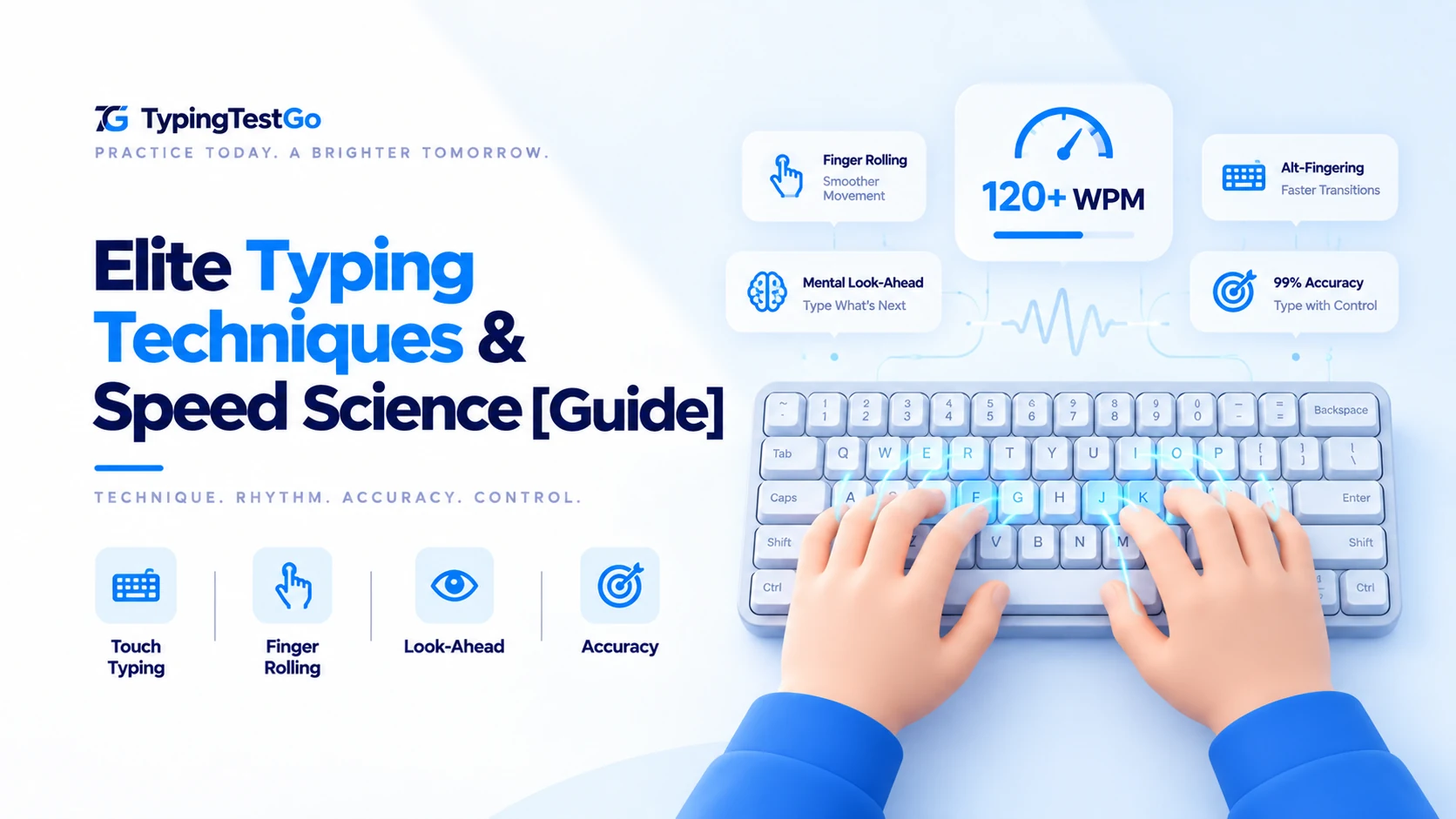
There comes a point in your typing journey"”usually right around the 120 WPM mark"”where just "typing more" stops working. You hit a wall. When you watch the true speed demons cross the 200 WPM threshold, it's obvious they aren't just moving their fingers faster. Compared to the average human typing speed, they are physically interacting with the keyboard differently.
The world's fastest typists have fundamentally remapped their brains and hands to eliminate friction. If you want to know how the legends pull it off, we need to break down the elite typing mechanics that nobody teaches you in high school keyboarding class.
Why is finger rolling the secret to breaking the WPM wall?
If you're stuck at a plateau, you're probably still "tapping." This means you push a key down, let it back up, move to the next key, and repeat. That travel time is killing your speed.
Elite typists don't tap; they roll. Imagine drumming your fingers on a desk from your pinky to your index finger in one fluid motion. That's what typing a word like "the" looks like at 200 WPM. The fingers are in constant, overlapping motion. On a good mechanical keyboard, an elite typist is pressing the 'H' before the 'T' is even fully released. To master finger rolling, you have to stop thinking of words as a string of letters, and start feeling them as a single physical "chord" or wave across your hand.
What is "Alt-Fingering" and why do elite typists use it?
Remember when you learned the "proper" home row technique? Forget it. The golden rule you were taught"”always use the exact same finger for the exact same key"”is actually a massive bottleneck.
Welcome to alternative fingering typing, or alt-fingering. The absolute worst thing for your speed is a "same-finger bigram," which is when you have to type two consecutive letters using the same finger. Instead, top typists dynamically remap their hands on the fly. For example, if you're typing the word "YOU", the standard method forces your right index finger to jump from Y to U. An elite typist will comfortably hit the 'U' with their middle finger just for that specific word to maintain their speed. They memorize hundreds of these situational workarounds.
| Letter Cluster / Word | Traditional Home-Row Method | Elite Alt-Fingering Execution | Biomechanical Advantage |
|---|---|---|---|
| "YOU" / "YO" | Right Index (Y) → Right Index (U) | Right Index (Y) → Right Middle (U) | Eliminates severe same-finger hurdle; cuts bigram latency from ~160ms to ~45ms. |
| "ED" / "DE" | Left Middle (E) → Left Middle (D) | Left Ring (E) → Left Middle (D) | Converts a clumsy same-finger jump into a smooth inward finger roll. |
| "CR" / "BR" | Left Middle (C) → Left Index (R) | Left Index (C) → Left Middle (R) | Relieves cramped bottom-to-top curl; prevents wrist abduction. |
| "PUNCTUATION" (P-U) | Right Pinky (P) → Right Index (U) | Right Ring (P) → Right Middle (U) | Keeps right wrist neutral instead of flaring the elbow outward. |
| "LK" / "LO" | Right Ring (L) → Right Middle (K) | Right Ring (L) → Right Index (K) | Avoids awkward ring-to-middle lateral stretch on downward strokes. |
Biomechanical Wave Mechanics: Inward vs. Outward Rolls
Human hands do not move symmetrically in both directions. Due to the arrangement of the flexor digitorum profundus tendons in the forearm, inward rolls (drumming fingers from pinky toward index finger, like pressing A → S → D → F) generate significantly more force and coordination than outward rolls (index toward pinky).
Competitive speed typists take advantage of this anatomy by tilting their wrists slightly inward (~5 to 8 degrees). This subtle angular shift aligns the natural tendon pull angle, transforming difficult outward sequences like "poi" or "lkj" into neutral downward compressions.
How does a "Mental Look-Ahead" buffer enable 200+ WPM?
This is where things get slightly superhuman. If you are reading the word you are currently typing, your brain's reaction time is slowing you down.
To hit the top of the leaderboards, you need a typing mental look-ahead buffer. Elite typists read 2 to 5 words ahead of where their fingers actually are. They use this buffer to regulate their rhythm. When they see a long, smooth word coming up, they accelerate; when they see bizarre punctuation approaching, they buy themselves milliseconds of processing time because they saw it coming a sentence away.
How do the world's fastest typists actually train?
So, how do you practice this without losing your mind? Let's take a page from the greats:
- The Sean Wrona Technique (Accuracy is God): Wrona is legendary for his sustained marathon speeds. His core philosophy? Never trade accuracy for speed. A single typo shatters your rhythm and destroys your look-ahead buffer. Practice at the absolute maximum speed where you can still maintain 99% accuracy, and not a hair faster.
- The MythicalRocket Habits (Embrace the Burst): On the flip side, Rocket holds the insane 300+ WPM burst records. His trick is to overload the nervous system. By forcing yourself to type slightly faster than you comfortably can-a method we detail in our roadmap to 200 WPM-your brain adapts to the chaos. Afterwards, your "normal" speed will naturally feel much slower and easier to control.
| Block & Time | Focus Mode | Neuromuscular Objective |
|---|---|---|
| Minutes 0–3 | Single-Hand Trigram Calibration | Slow metronomic finger isolation on left-hand (ASDF/QWER) and right-hand (JKL;/UIOP) clusters to warm up synovial fluid. |
| Minutes 3–7 | Neural Overload Sprints (15s bursts) | Short 15-second sprints on common 200-word pools, intentionally pushing finger velocity beyond conscious control to expand the lookahead horizon. |
| Minutes 7–11 | Sudden-Death Accuracy Drilling (Master Mode) | Tests configured to abort immediately on a single typo. Forces motor cortex to prioritize zero-error rhythm over reckless speed. |
| Minutes 11–15 | Complex Corpus & Punctuation Endurance | Continuous 2-to-3-minute tests on uncurated literature passages containing capitals, numbers, and quotation marks. |
By rotating through these four targeted modalities in a single 15-minute daily block, you simulate the exact training regimens used by competitive speedrunning typists and verbatim courtroom reporters.
Is a laptop keyboard holding back your top-end speed?
Finally, we have to talk about gear. You simply cannot execute a perfectly overlapping 200 WPM finger roll on a squishy laptop membrane keyboard where the keys stick. Elite typists rely on specialized mechanical switches and keyboards with 1000Hz+ polling rates so their inputs register with zero latency.
If you want to implement these habits, jump on a site like Monkeytype, turn on the "Master" setting (which ends the test instantly if you make one mistake), and start practicing your look-ahead buffer. Film your hands in slow motion if you have to. Eliminate the wasted movement, and watch your WPM skyrocket.
Concert Pianist Ergonomics: The Floating Wrists Method
Watch any competitive typist hitting 180+ WPM in live competition and you will notice a consistent postural habit: their wrists never touch the desk or a palm rest. Anchoring your wrist creates a fixed pivot point, forcing your fingers to stretch laterally at awkward angles.
By adopting the Floating Hands posture—elevating wrists 1 to 2 centimeters above the keyboard frame, exactly like a classical concert pianist—your larger forearm and shoulder muscles handle lateral transitions. This keeps finger joints completely relaxed, dramatically lowering fatigue and unlocking effortless fluid rolls across the entire layout.
Diagnose Your Rolling Latency
Are you tapping or rolling? Our elite diagnostic tool analyzes the millisecond-gap between your keystrokes to tell you if your mechanics are built for 200 WPM or if you're stuck in the "tapping" trap.
Run Mechanics Audit →