
How Do I Calm My Anxiety While Taking Typing Tests? A Survival Guide
I still remember my first official data entry assessment. Sitting in a sterile recruitment office, staring at a beige monitor. At home, I could comfortably cruise at 65 WPM. But the moment the proctor clicked "Start" and the large red timer began counting down from 5:00... my hands turned into concrete.
My palms were sweating, my heart was racing, and I couldn't seem to hit a single key correctly. I finished that test at an embarrassing 38 WPM. Typing test anxiety is real, and it sabotages thousands of job applications every single day. Here is exactly how to hack your nervous system and type at your true speed when it matters most.
The Physiology of a Freeze Response
Why do you suddenly forget how to type when a clock is ticking? It is not because you are a bad typist; it is because of basic human biology. When you perceive a threat (in this case, failing a job assessment) your amygdala triggers a fight or flight response. Adrenaline floods your system, blood rushes to your major muscle groups, and your fine motor skills (the tiny, delicate movements of your fingertips) are significantly impaired.
Worse, this anxiety shifts your brain out of the automatic procedural memory where touch typing lives and forces you back into conscious, manual processing. You start thinking about where the K key is located, and the moment you think about typing, you slow down by fifty percent.
Beware of Pre-Test Caffeine and Sugar
When preparing for an important assessment, many people reach for a large cup of coffee or an energy drink to boost their alertness. This is a massive mistake. Caffeine is a central nervous system stimulant. It naturally increases your resting heart rate and can induce mild tremors in your hands.
When you combine caffeine-induced tremors with the natural adrenaline spike of performance anxiety, your fingers will literally vibrate above the keyboard. You will accidentally double-tap keys and press neighboring letters. Stick to water or herbal tea before your exam. Hydration ensures your muscles function optimally without the artificial jitter.
Step 1: The Focus Mode Desensitization Protocol
The most common trigger for typing anxiety is the visual feedback loop. You make one mistake, you see your WPM counter drop from 60 to 55, you panic, you make three more mistakes, and your WPM plummets to 40.
The Fix: You need to practice blind. On TypingTestGo, we built a specific feature for this called Focus Mode in our 1-minute typing test and 5-minute exam mode. When activated, it hides the countdown timer, it hides your live WPM score, and it hides your error count. You are forced to just look at the text and type. By practicing this way for two weeks leading up to an exam, you train your brain to stop constantly checking its own performance.
Step 2: The Three-Second Restart Technique
Sometimes the panic sets in right in the middle of a paragraph. You misspell three words in a row, and your brain completely short circuits. Most typists will try to forcefully power through the rest of the sentence, making even more errors.
The Fix: Use the Three-Second Restart. If you feel your fingers stumbling uncontrollably, literally stop typing. Take your hands off the keyboard completely. Close your eyes for exactly three seconds. Take one deep breath, place your index fingers back on the F and J home row bumps (as taught in our touch typing fundamentals guide), and resume. You lose three seconds of time, but you prevent thirty seconds of catastrophic errors.
Step 3: The Ignore the Typo Momentum Rule
Anxious typists share a common destructive habit: the Backspace Panic. They hit the wrong key, gasp, and furiously tap the backspace key four times, deleting perfectly good letters in the process, only to re-type the exact same mistake because their hands are shaking.
The Fix: You must accept that mistakes are inevitable. Your goal is not perfection; your goal is maintaining flow. If you misspell a word, calmly hit backspace once or twice. If it is completely botched, just hit the spacebar and move on to the next word. Most professional assessments allow for a five percent error rate without penalty. Do not let a single misspelled word ruin your rhythm for the next thirty seconds.
Step 4: Box Breathing and Physical Reset
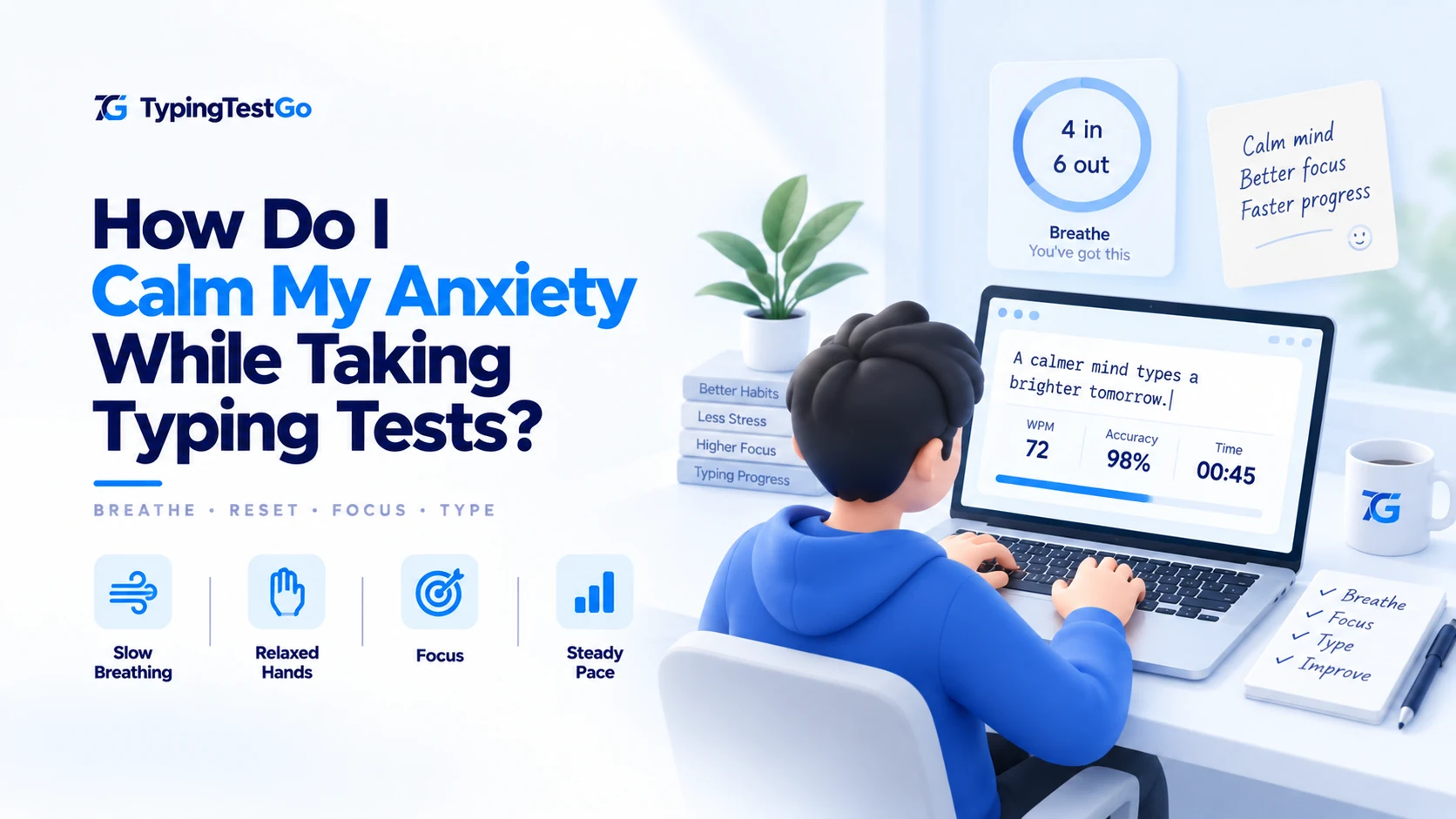
You cannot talk yourself out of a physiological adrenaline spike, but you can breathe your way out of it. If you sit down for an exam and feel your heart racing, do not start typing immediately. The timer has not started yet.
-
1
Drop Your Shoulders: Anxiety makes your shoulders creep up to your ears. Consciously force them down and relax your neck.
-
2
Box Breathing: Inhale for 4 seconds, hold for 4 seconds, exhale for 4 seconds, hold for 4 seconds. Do this three times. It stimulates the vagus nerve and literally slows your heart rate.
-
3
The Warmup Sprint: Never take a 5-minute test cold. If the proctor allows it, take a short warmup sprint first. Get the blood flowing to your cold fingers before the real assessment begins.
Step 5: The 5-Minute Pre-Test Neuro-Somatic Warm-Up Protocol
Cold testing rooms and seated immobility restrict peripheral blood flow to distal extremities—the exact micro-muscles responsible for rapid keystroke articulation. Executing a systematic 5-minute warm-up right outside the assessment room restores tactile feedback and calms central nervous system arousal.
| Phase & Timing | Exercise / Technique | Biomechanical & Neurological Mechanism |
|---|---|---|
| Minute 0–1 | Dual Nasal "Physiological Sigh" (3 cycles) | Two rapid inhales through the nose followed by a slow, extended mouth exhale. Re-inflates collapsed alveoli and stimulates parasympathetic vagal braking to lower resting heart rate by 8–15 BPM. |
| Minute 1–2 | Wrist Rotations & Tendon Glides | Gentle circular wrist rotations followed by straight-to-hook fist glides. Disperses viscous synovial fluid along the carpal tunnel, restoring finger flexibility and preventing stiffness. |
| Minute 2–3 | Finger Independence Isometric Presses | Pressing fingertips against a firm desk surface one digit at a time without moving neighboring fingers. Activates the primary motor cortex hand map, sharpening tactile feedback. |
| Minute 3–4 | Subvocalization Silencing (Gaze Expansion) | Softening visual focus to take in peripheral edges of the monitor instead of intensely tunneling on a single letter. Peripheral vision suppresses the sympathetic fight-or-flight response. |
| Minute 4–5 | Low-Stakes Rhythm Tapping (1-minute pace test) | Tapping out a comfortable metronomic cadence on your thighs or desk to lock in muscle rhythm before looking at test paragraphs. |
By shifting from passive dread to an active physical routine, your prefrontal cortex regains executive control over your motor patterns, preventing the shaking and freezing that destroys test scores.
Cognitive Reframing
Your brain has a hard time telling the difference between extreme anxiety and extreme excitement. Both states cause a rapid heart rate, sweaty palms, and heightened alertness. If you tell yourself "I am terrified of failing," your brain interprets those physical symptoms as danger.
Instead, try Cognitive Reframing. When you feel the adrenaline rush, tell yourself out loud: "I am excited to show off how fast I can type." It sounds silly, but clinical studies show that reframing anxiety as excitement significantly improves performance in timed environments.
The Verdict: Reclaiming Your Speed
Typing test anxiety does not define your skill level. It is merely a biological hurdle that you can train yourself to jump over. By using Focus Mode to ignore the clock, accepting your typos gracefully, avoiding caffeine, and physically regulating your heart rate, you can walk into any assessment room and type exactly as well as you do on your couch at home.
Practice Without the Pressure
Turn on Focus Mode, hide the timer, and take a deep breath. Start building your stress-resilience right now.
Start a Practice Test →